Application Note / 2026-09-03
CNC Machine Tending Part-Present Sensing Checklist: Material, Gripper and Workholding States
A part-present sensing checklist defines the physical and control states each handoff must distinguish, the evidence used, and the unresolved action before the next motion.
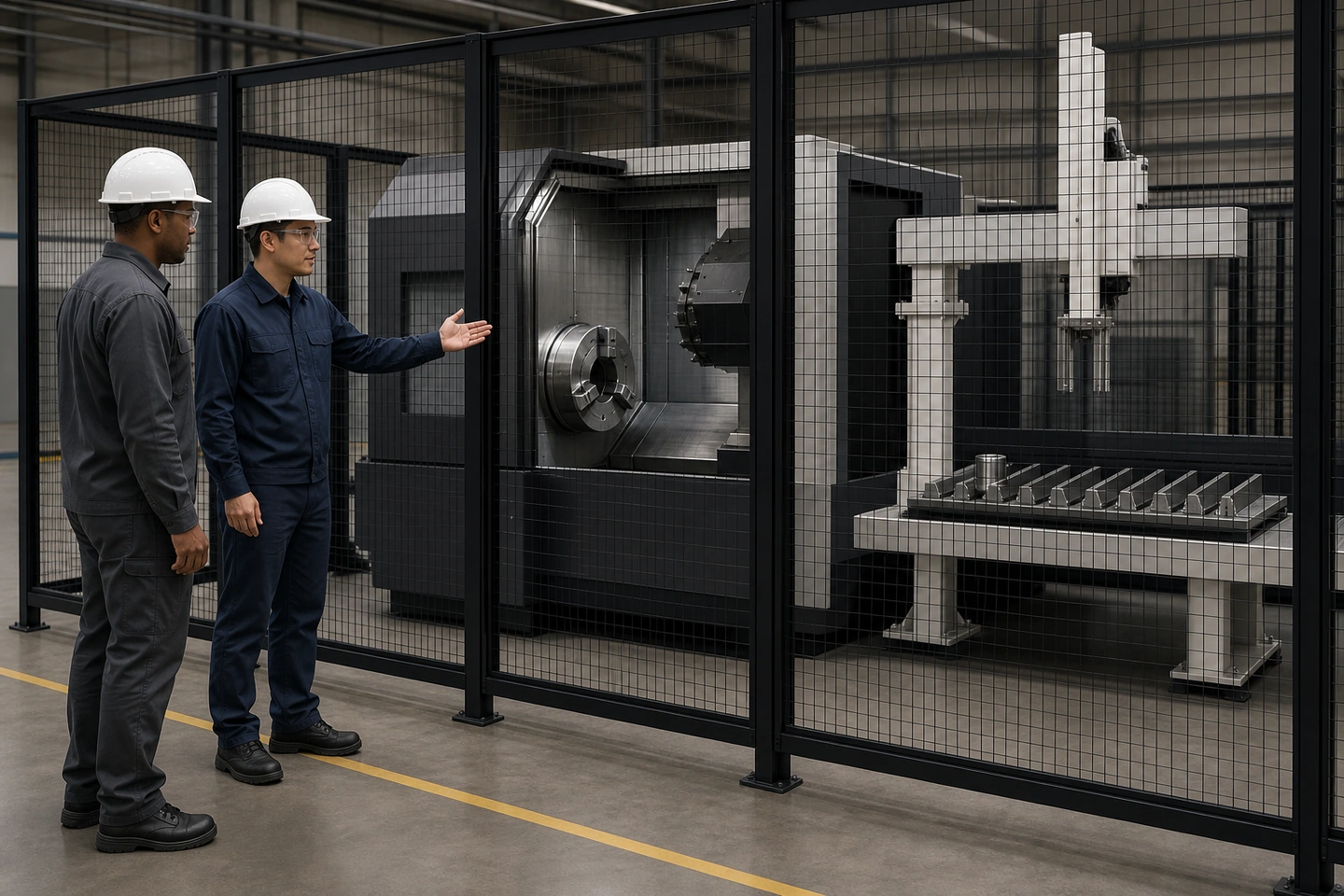 Application scene visualization / actual evidence, state definitions and sensing choices remain project-specific
A CNC machine tending part-present sensing checklist should define, at three checkpoints, the expected physical state, separate abnormal states, permitted position and orientation, evidence source, related control state and sequence point, revision, owner and unresolved action. The checkpoints are the material location, the gripper and the CNC chuck or fixture. This input sheet does not select a sensor, design I/O or a safety function, or prove detection performance, machine compatibility or acceptance.
Define the three checkpoints and the question at each one
At the material location, ask whether the expected part is present in the named supply position and in a permitted orientation. At the gripper, ask whether the intended part is actually held in the expected contact and orientation condition. At the CNC workholding, ask whether part evidence matches the actual spindle, chuck or fixture, door and machine state at that handoff.
The conceptual one-CNC material flow can help identify these handoffs. It does not define the project’s physical states, sensing method or sequence logic. For machine-to-robot states and permissive context, use the CNC machine tending interface checklist; this page keeps the narrower part-evidence scope.
| Checkpoint | Direct project question | State that must be defined | Evidence status |
|---|---|---|---|
| Material location | Is the expected part in the named position and permitted orientation? | Present, absent and separate abnormal inputs | Confirmed / site verification / project decision |
| Gripper | Is the intended part actually held as expected? | Occupied, empty, loss and uncertain | Confirmed / site verification / project decision |
| CNC chuck or fixture | Does part evidence match the current machine handoff state? | Present, absent, seated/oriented or unresolved | Confirmed / site verification / project decision |
Material location: keep missing, stacked, wrong and uncertain states separate
At the material location, record the named nest or supply position, the allowed part state and orientation, and whether the physical part and nest match the selected control state. Missing material, a stacked part, wrong orientation and an uncertain state should remain separate abnormal inputs because they describe different observations and unresolved actions.
Do not collapse all four conditions into “no part”. The checklist also does not claim automatic identity recognition, de-stacking, wrong-orientation detection or zero-mix performance, and it does not prescribe pallet geometry, nest tolerance or replenishment logic.
Gripper: actuator position is not proof that the intended part is held
An actuator or cylinder position describes one mechanism state; by itself, it does not prove that the intended part is present, correctly contacted or in the permitted orientation. Record gripper occupied, empty, loss-of-part and uncertain states separately, together with the relevant contact and orientation condition, evidence source and expected transition before the next motion.
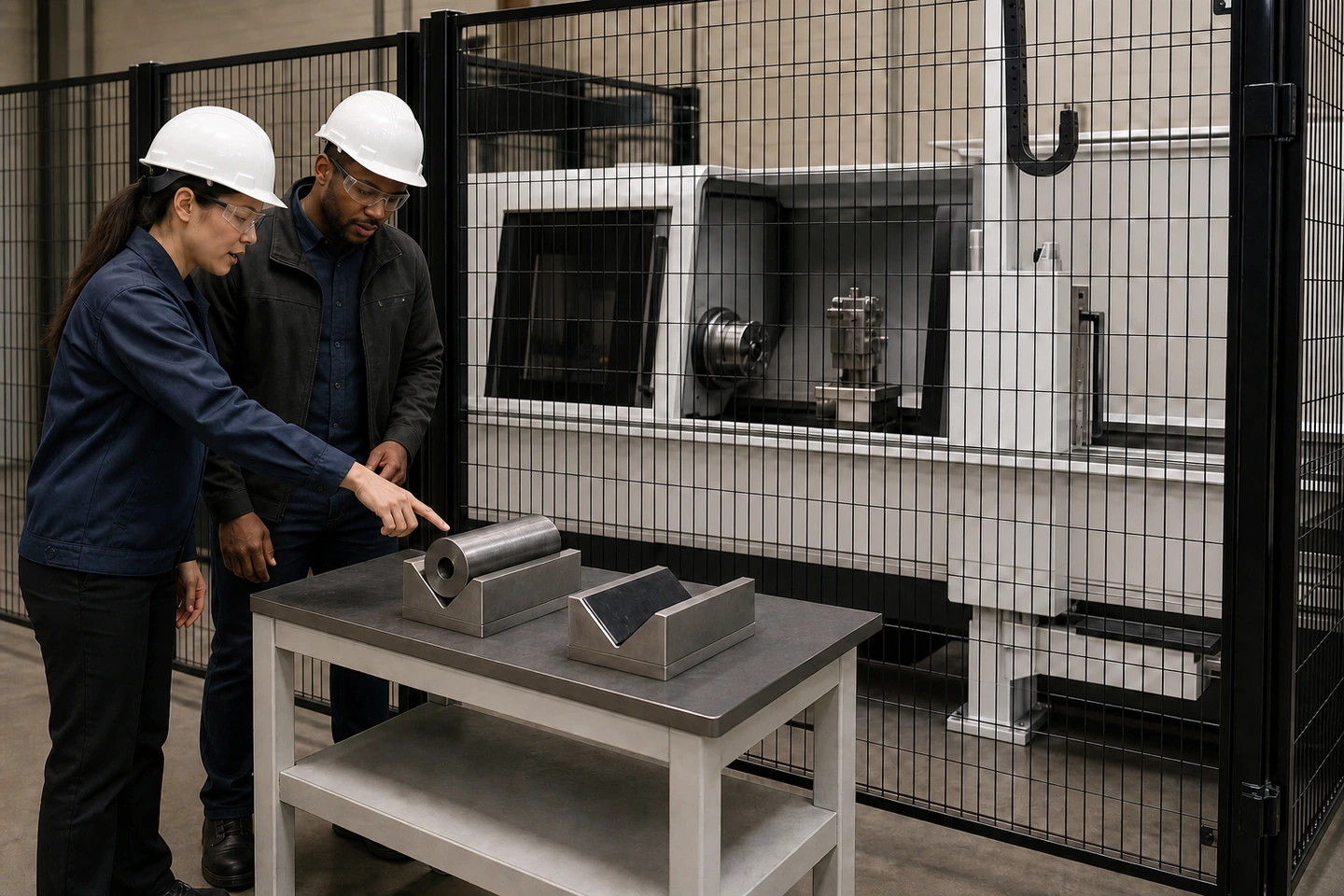 Application scene visualization / actual state definitions and evidence remain project-specific
Mechanical contact and gripper design belong to gripping assessment. This checklist does not specify jaw force, sensor type, threshold, mounting point, gripping accuracy, diagnostic coverage or a loss-of-part response.
CNC workholding: bind the evidence to the actual handoff state
At the CNC chuck or fixture, record presence and seating or orientation evidence alongside the actual spindle, workholding, door and machine state at the handoff. Identify whether the evidence comes from an observed physical condition, an actual machine signal or an unresolved project input.
A machine-state indication cannot silently stand in for evidence that a part is present or seated. Likewise, a part-present indication does not by itself prove identity, correct orientation, chuck seating, machine compatibility or that the next cycle is permitted. Interface logic, wiring, interlocks and permissives remain outside this article.
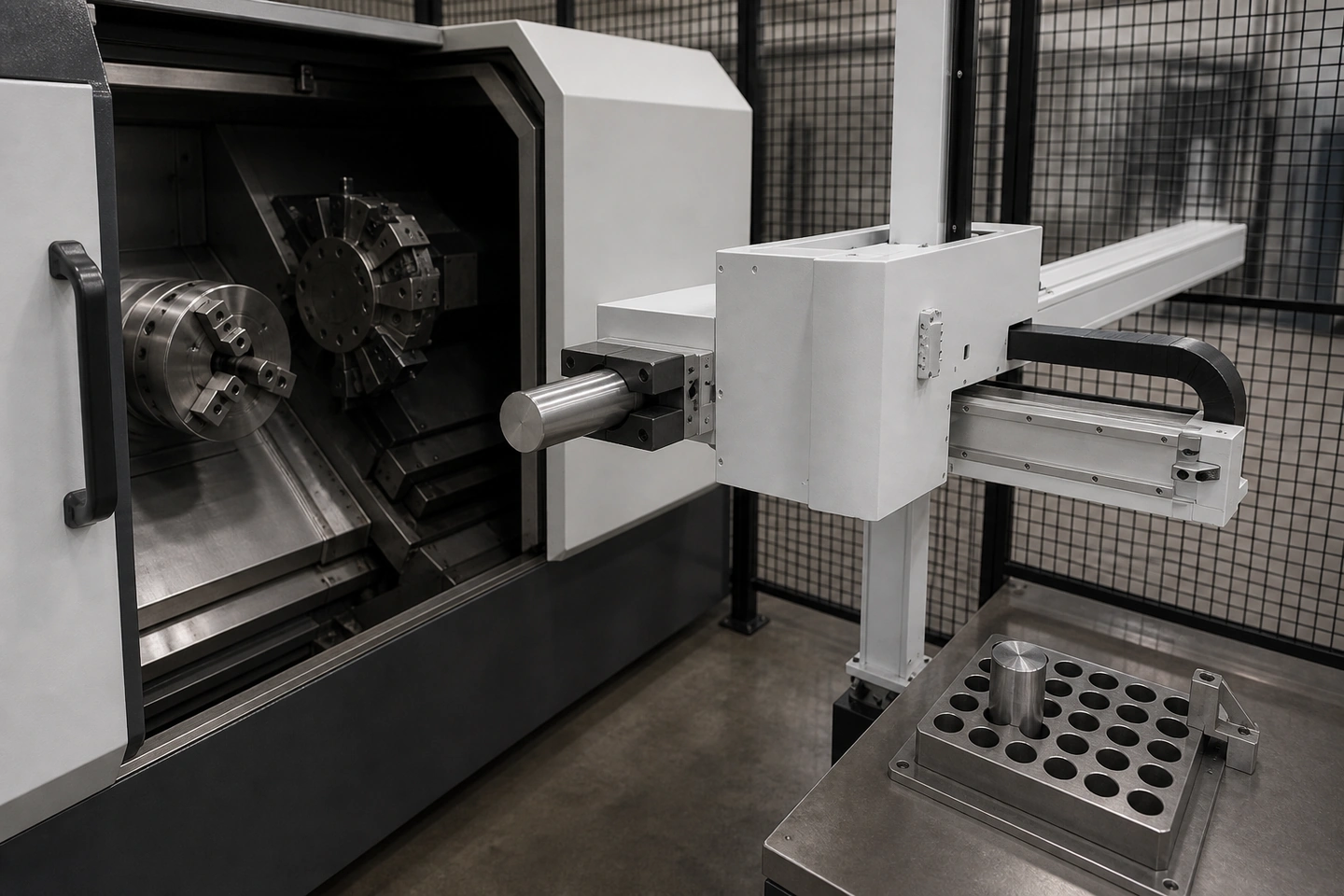 Application scene visualization / not sensor-performance evidence
Make every checkpoint traceable
For every checkpoint, retain the expected state, each abnormal state, evidence source, control-state name, point in the sequence, configuration or document revision, evidence owner and unresolved action. Do not invent signal names, PLC addresses, sampling times, diagnostic states or owners; keep those entries open until the actual project supplies them.
Can one signal prove presence, position and orientation?
Not automatically. Presence, expected position and permitted orientation are different questions, so one indication must not be reused to answer all three unless the project has separate evidence supporting each claim. The checklist records that evidence boundary without designing the logic.
The high-mix changeover checklist can provide revision and part-state control context. Reach and clearance inputs belong to the separate CNC reach-study checklist.
Prepare representative verification inputs without claiming performance
The evidence package should include representative rough and finished parts, actual machine states and signals, normal contamination conditions, and defined missing-material, empty-grip or loss-of-part cases. These are verification inputs, not a test result.
QIXING’s retained, hash-verified public manual copy lists empty-grip detection, but its current public download URL is unavailable. Availability and behaviour therefore remain subject to model, configuration and project verification. This statement does not establish accuracy, response time, false-positive or false-negative rate, diagnostic coverage, universal availability or safety certification.
Use project-specific validation planning when the actual configuration, representative parts, states and abnormal cases are ready to be tested. Completing this input sheet does not prove sensor performance, compatibility, acceptance or production release.
Fillable part-present sensing input matrix
| Checkpoint | Expected physical state | Separate abnormal states | Position/orientation condition | Evidence source | Control-state name and sequence point | Revision/owner | Unresolved action |
|---|---|---|---|---|---|---|---|
| Material location | Project input | Missing / stacked / wrong orientation / uncertain | Project input | Project input | Project input | Project input | Project input |
| Gripper | Occupied or empty as expected | Empty grip / loss / uncertain | Project input | Project input | Project input | Project input | Project input |
| CNC chuck or fixture | Project input | Absent / not seated / wrong orientation / uncertain | Project input | Project input | Project input | Project input | Project input |
Do not prefill a sensor type, location, threshold, I/O address, permissive logic, diagnostic coverage, response time, performance, compatibility or acceptance status. Mark each unresolved entry with its evidence owner and next project action.
Frequently asked questions
What is part-present sensing in CNC machine tending?
In this checklist, it is the project evidence used to distinguish expected presence, absence and relevant abnormal states at the material location, gripper and CNC workholding. It does not refer to one universal device or method.
How should empty-grip and loss-of-part states be documented?
Keep them separate from an expected occupied state and from an uncertain state. Record the physical condition, contact and orientation context, evidence source, sequence point, revision, owner and unresolved action.
Should the checklist specify a sensor type or I/O address?
No. It should define what state must be evidenced and where in the sequence it matters. Sensor selection, mounting, thresholds, signal names, I/O and logic require separate project engineering.
Is a part-present indication an acceptance or safety result?
No. An indication does not by itself prove identity, seating, orientation, detection performance, safe operation, compatibility or production acceptance. Those conclusions require separate project evidence and responsible decisions.
Sources and use boundaries
This article uses only QX017-F01 through QX017-F06, QX-FCT-20260903-002, QX-FCT-20260826-006, QX-FCT-20260828-002, QX-FCT-20260830-002, QX-FCT-20260829-002 and QX-FCT-20260826-007. The sources support state-and-evidence inputs at three handoffs; they do not support a sensor recommendation, I/O design, safety function or detection-performance claim.
Submit the three-handoff evidence inputs
Prepare the named material positions, representative rough and finished parts, permitted orientations, gripper occupied and empty conditions, CNC workholding state, actual machine-state names, evidence sources, revisions and unresolved questions. Then submit the part-present evidence inputs for a one-CNC handoff review. The review does not promise a sensor choice, compatibility, performance, acceptance or production release.