Application Note / 2026-08-29
High-Mix CNC Machine Tending Changeover Checklist: Parts, Tooling and Program State
A high-mix changeover is ready for review only when the selected part family is tied to its physical tooling, material presentation and intended control state, then checked with representative parts and actual machine signals.
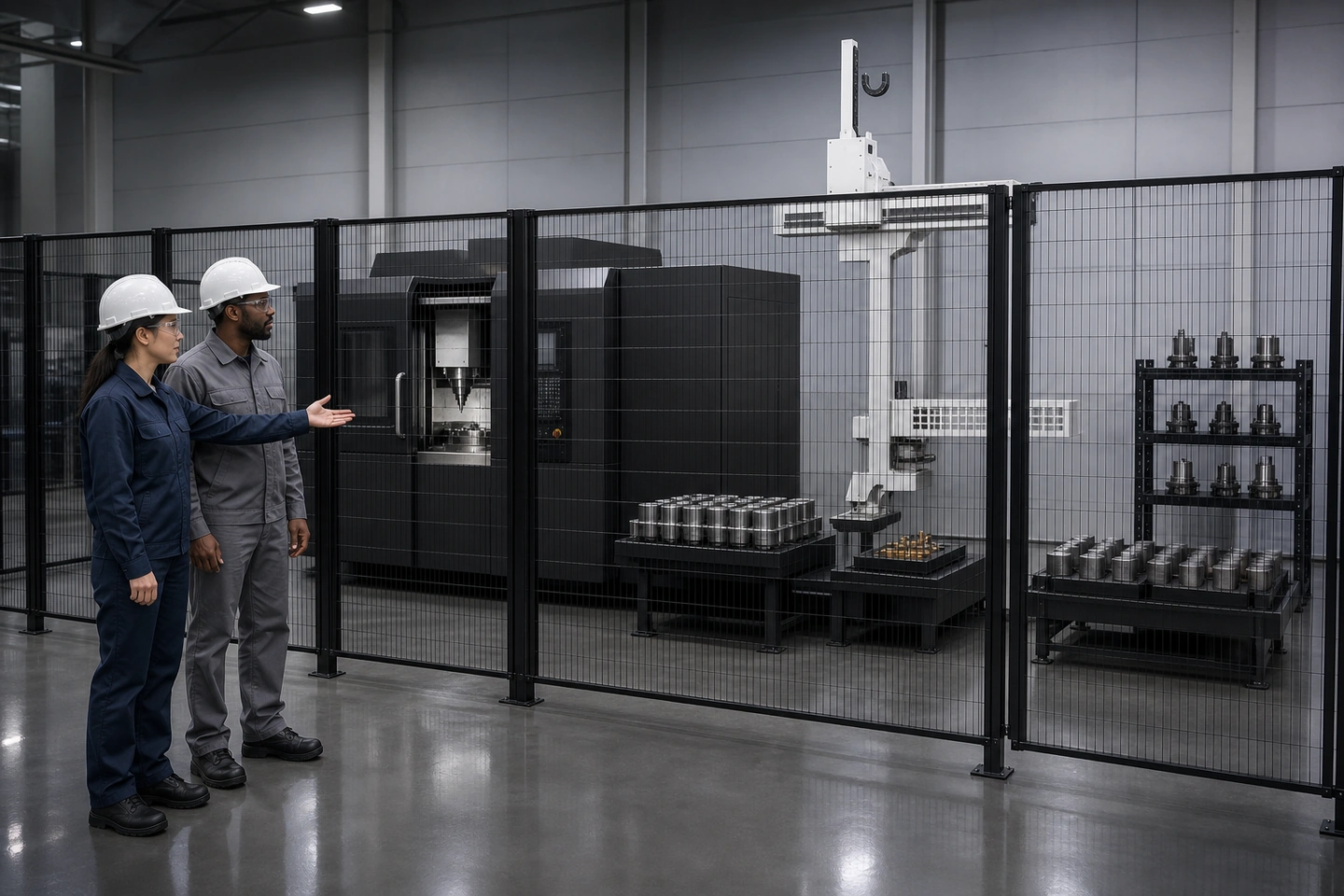 Application scene visualization / final layout subject to engineering review
A high-mix CNC machine tending changeover checklist should connect six things before the cell returns to production: part-family data, workholding and gripper setup, raw/finished/reject presentation, intended CNC and robot control state, reconciliation of physical versus selected state, and representative-part restart verification. Record confirmed information, missing measurements and project decisions separately. The checklist is a release-review framework, not a universal recipe or a promised changeover time.
Define the release unit before changing the cell
Treat one part family and one approved changeover state as the release unit. A family name by itself is not enough: the release record needs to identify the part condition, the tooling and material arrangement physically fitted to the cell, and the control state intended for that combination.
Use three statuses throughout the document:
| Review status | Meaning | Required action |
|---|---|---|
| Confirmed | Current drawing, measurement, setup record or observed state supports the entry | Record the evidence and revision |
| Measurement required | Geometry, mass, orientation, clearance or actual machine state is missing | Assign a measurement at the real part or cell |
| Project decision required | The integration team must define, implement and validate the item | Name the owner and release evidence |
The single-machine CNC tending flow provides the application context. This checklist stays with a planned family change at one cell; it does not select a robot architecture or turn the flow into a released production layout.
Build a controlled part-family matrix
Create separate entries for the blank and finished part. Record their geometry, dimensions, mass, centre of gravity, permitted gripping surfaces, orientation and surface-protection constraints. If a measurement is unavailable, keep the field open rather than inserting a typical range.
| Part-family field | Blank | Finished part | Evidence or open item | Status |
|---|---|---|---|---|
| Part identity and revision | ______ | ______ | ______ | ______ |
| Geometry and dimensions | ______ | ______ | ______ | ______ |
| Mass and centre of gravity | ______ | ______ | ______ | ______ |
| Permitted gripping surfaces | ______ | ______ | ______ | ______ |
| Prohibited/contact-sensitive surfaces | ______ | ______ | ______ | ______ |
| Required orientation | ______ | ______ | ______ | ______ |
| Surface-protection constraints | ______ | ______ | ______ | ______ |
This matrix does not prove that one gripper covers every family. It also does not establish tolerance capability or a validated application list. Use CNC loading gripper design for the separate engineering topic; the changeover record should only identify which project-verified setup belongs to the selected family.
Bind workholding and gripper setup to the family
The release record should identify the actual chuck or fixture condition and the jaw/finger set, adapters, sensors and cleaning state needed for the family. It should also show which clearances and gripping confirmations remain to be checked on the real cell.
| Tooling item | Required state for this family | Installed/observed state | Confirmation source | Status |
|---|---|---|---|---|
| Chuck or fixture | ______ | ______ | ______ | ______ |
| Jaw or finger set | ______ | ______ | ______ | ______ |
| Adapter or quick-change element | ______ | ______ | ______ | ______ |
| Relevant sensor/confirmation | ______ | ______ | ______ | ______ |
| Clearance to machine/tooling | ______ | ______ | ______ | ______ |
| Cleaning or contamination check | ______ | ______ | ______ | ______ |
Do not fill this table with an assumed jaw force, sensor threshold, chuck setting, payload margin or tooling life. Those values require project evidence and the actual hardware. A named sensor also does not prove that every wrong setup will be detected.
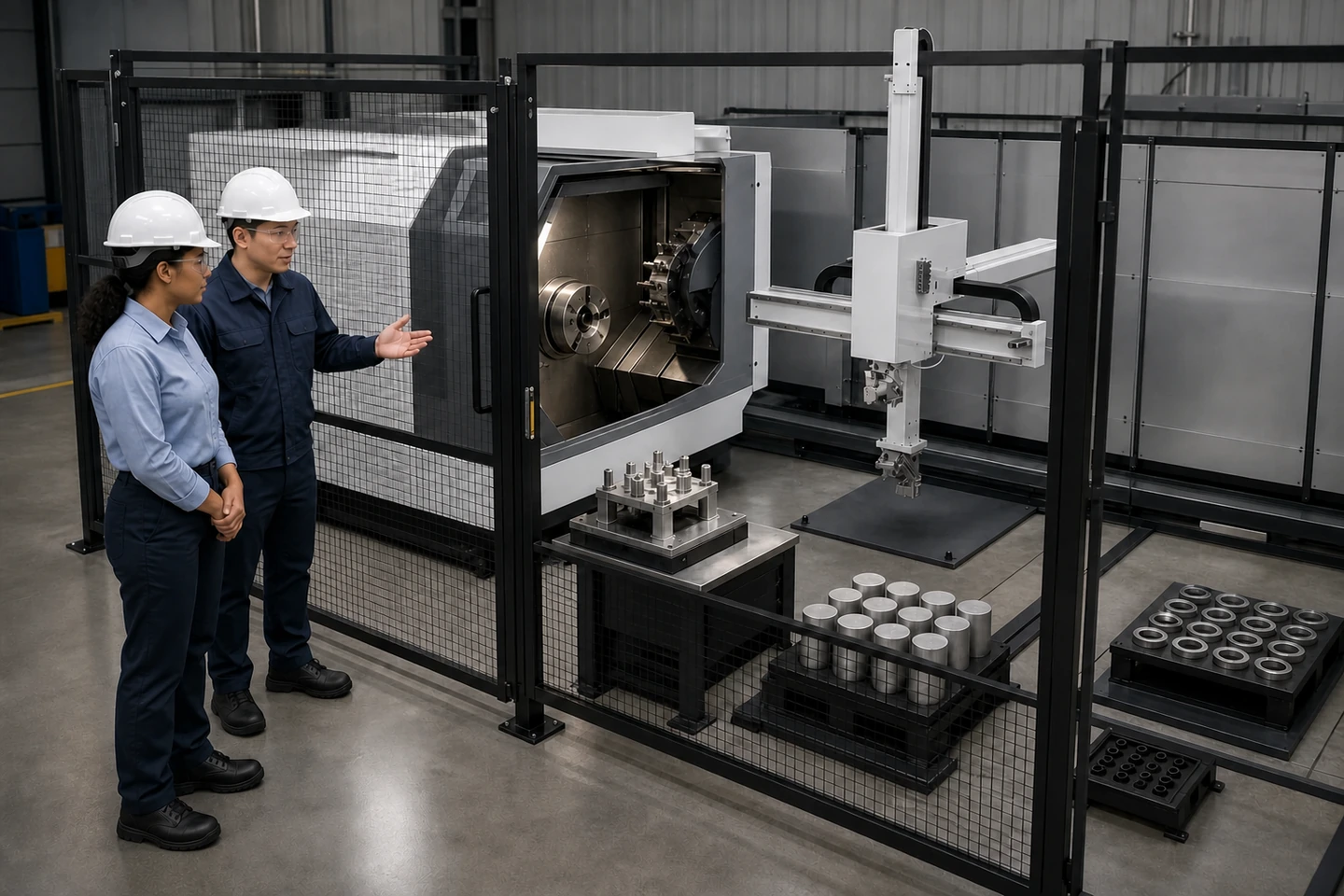 Application scene visualization / final layout subject to engineering review
Release raw, finished and reject material presentation
A part-family change is incomplete if old material remains in a nest, buffer or gripper without a defined disposition. Record raw, finished and reject positions; nest identity; permitted orientation; replenishment side; and what happens to remaining material before the next family is released.
| Material-state field | Released requirement | Physical state found | Action before release | Status |
|---|---|---|---|---|
| Raw-part position and nest identity | ______ | ______ | ______ | ______ |
| Finished-part position and nest identity | ______ | ______ | ______ | ______ |
| Reject/unknown-part position | ______ | ______ | ______ | ______ |
| Permitted part orientation | ______ | ______ | ______ | ______ |
| Replenishment side | ______ | ______ | ______ | ______ |
| Remaining material from prior family | ______ | ______ | ______ | ______ |
| Buffer contents, if present | ______ | ______ | ______ | ______ |
The table does not define tray capacity, buffer quantity or automatic family recognition, and it cannot support a zero-mix claim. For broader context on maintaining part identity and buffer state, use the separate two-machine article without copying its architecture into this one-machine checklist.
Bind product identity to the intended control state
For each family, identify the intended CNC program state, robot program state, parameter group or template, tooling selection and material state. The record should also say who may edit each item, who reviews it and what evidence releases it.
The public 2026 QIXING manual lists concepts such as parameter groups, stacking offset, program templates and graphical status. These are manual-described capabilities only and remain subject to model, configuration and project validation. They do not establish automatic recipe validation, version control, access control, error-proofing or universal availability.
| Control-state item | Intended family state | Current selected state | Edit/review owner | Release evidence |
|---|---|---|---|---|
| CNC program or setup identity | ______ | ______ | ______ | ______ |
| Robot program or template identity | ______ | ______ | ______ | ______ |
| Parameter group, if applicable | ______ | ______ | ______ | ______ |
| Tooling selection | ______ | ______ | ______ | ______ |
| Material-state selection | ______ | ______ | ______ | ______ |
| Open change or deviation | ______ | ______ | ______ | ______ |
A displayed label or selected program is one part of the review. The physical cell still has to be reconciled with that control state.
Reconcile physical and control state before restart
Walk the cell and compare what is physically present with what the selected family and programs expect. At minimum, account for every nest, gripper occupancy, chuck or fixture condition, selected family, CNC program, robot program and any buffer contents.
| Reconciliation point | Physical state | Selected/control state | Match confirmed? | Action or owner |
|---|---|---|---|---|
| Workpiece in each nest | ______ | ______ | ______ | ______ |
| Gripper occupancy | ______ | ______ | ______ | ______ |
| Chuck or fixture condition | ______ | ______ | ______ | ______ |
| Selected part family | ______ | ______ | ______ | ______ |
| CNC program state | ______ | ______ | ______ | ______ |
| Robot program state | ______ | ______ | ______ | ______ |
| Buffer contents | ______ | ______ | ______ | ______ |
This is a human-readable release check. It does not imply that the interface detects every mismatch or that the system automatically selects the correct program or recovery path. The broader changeover and recovery boundaries remain a separate project consideration.
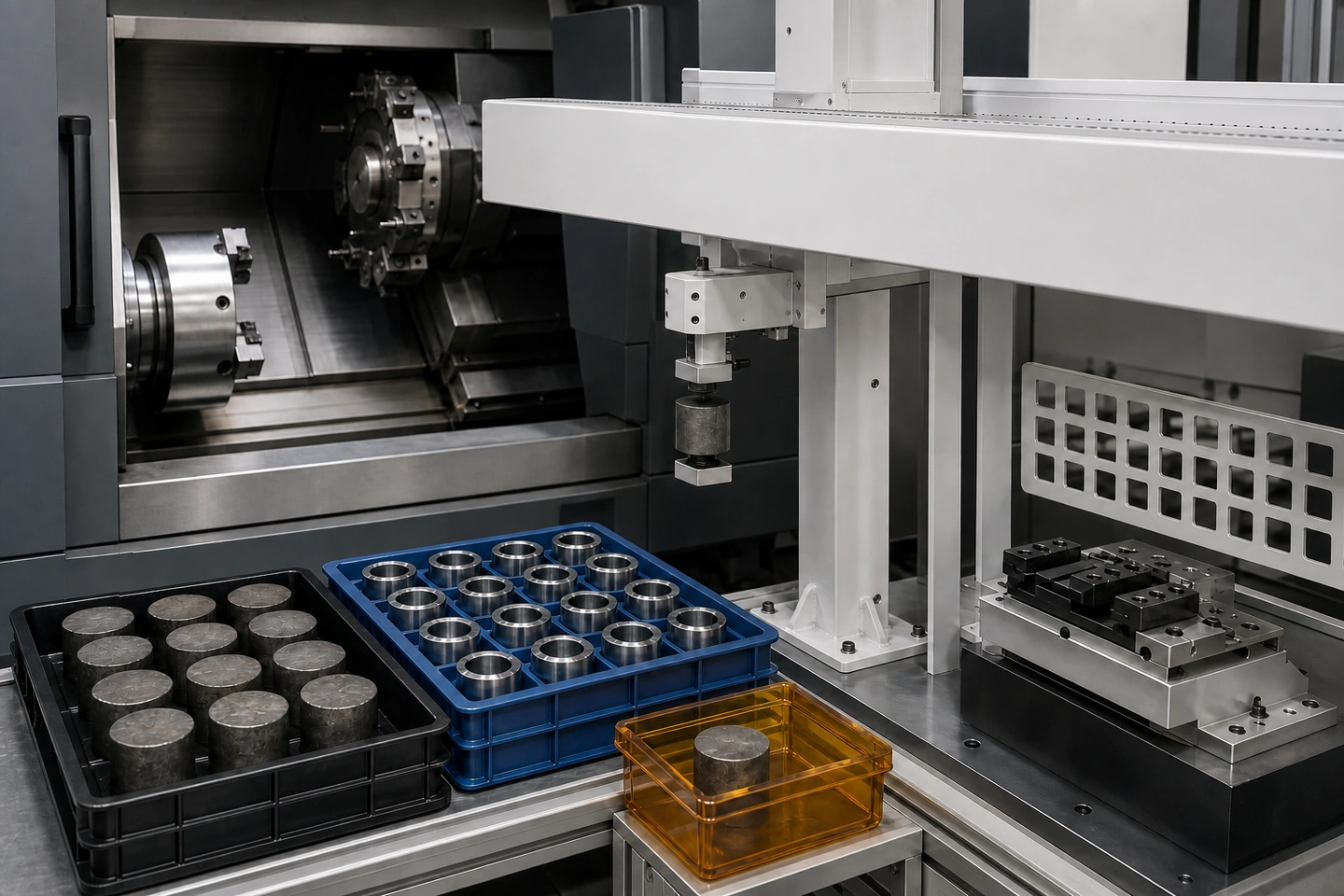 Application scene visualization / final layout subject to engineering review
Verify the released state with representative parts and actual signals
Before production expectations are released, use representative parts and the actual machine signals to review the intended sequence: pickup, loading, gripping confirmation, safe retreat, cycle start, finished-part return and abnormal recovery. Record observed results and unresolved conditions instead of converting the exercise into a performance claim.
| Verification point | Representative part/state | Actual signal or observation | Result | Open action |
|---|---|---|---|---|
| Raw-part pickup | ______ | ______ | ______ | ______ |
| Loading and workholding | ______ | ______ | ______ | ______ |
| Gripping confirmation | ______ | ______ | ______ | ______ |
| Safe retreat | ______ | ______ | ______ | ______ |
| Cycle-start handoff | ______ | ______ | ______ | ______ |
| Finished-part return | ______ | ______ | ______ | ______ |
| Abnormal recovery review | ______ | ______ | ______ | ______ |
The verify the full machine-tending sequence article explains why signals and representative trials matter, but this checklist makes no cycle-time, throughput, yield or unattended-running claim. If changeover work requires guard bypass or entry into a danger zone, review the applicable hazardous-energy boundary separately. This article is not a universal LOTO or restart procedure, and OSHA material cited in the fact pack does not establish global or project-specific compliance.
Release summary for the changeover package
A reviewable package should contain the controlled part-family matrix, tooling and workholding setup, material-position map, intended control state, remaining-material disposition, physical-to-control reconciliation and representative-part verification record. It should also separate confirmed data from measurements and project decisions that remain open.
Do not release the package on the basis of a family name or a single program selection. The team needs one consistent view of the part, hardware, material and control state intended for the next run.
Frequently asked questions
What should a high-mix CNC machine tending changeover checklist include?
It should include part-family data, chuck or fixture and gripper setup, raw/finished/reject positions, intended CNC and robot program or parameter state, a physical-to-control reconciliation, and representative-part restart verification.
Why use a part-family matrix?
The matrix keeps blank and finished conditions, gripping surfaces, orientation and protection requirements tied to one family. It also makes missing measurements visible instead of hiding them inside a generic recipe name.
What is the difference between physical state and control state?
Physical state is what is actually in the nests, gripper, chuck, fixture and buffer. Control state is the selected family, CNC and robot program state, parameter group or template. Both sides must be compared before restart.
What should happen to material left from the previous family?
Its identity, location and disposition should be recorded before the next family is released. The checklist does not prescribe a universal buffer quantity or claim automatic recognition.
Who should release a program or template change?
The project should name the editing, review and release owners and the required evidence. The public manual's program and parameter concepts do not prove that version control or access control is implemented in a specific cell.
How should the changeover be verified before production expectations are released?
Use representative parts and actual machine signals to review pickup through finished-part return and abnormal recovery. Record unresolved conditions; do not infer timing, yield or successful unattended operation from the checklist.
Sources and use boundaries
This article uses only QX008-F01 through QX008-F06, QX-FCT-20260826-006 and QX-FCT-20260826-007. QIXING pages and the public manual support the listed planning concepts, subject to model, configuration and project validation. The limited OSHA reference applies only where changeover work involves guard bypass or danger-zone entry; it is not a universal procedure or a compliance conclusion.
Submit a high-mix changeover package
Share the blank and finished-part family data, workholding and gripper setups, raw/finished/reject positions, intended CNC and robot program states, remaining-material rules and restart checks. Then submit part-family and changeover data so QIXING can review a high-mix changeover plan for one CNC tending cell.