Application Note / 2026-09-11
External vs Internal Gripping for Round Parts in CNC Machine Tending
A concept-level guide to outside and bore-side contact for round parts in a one-CNC tending cell, with the access questions that must stay open before a contact direction is considered.
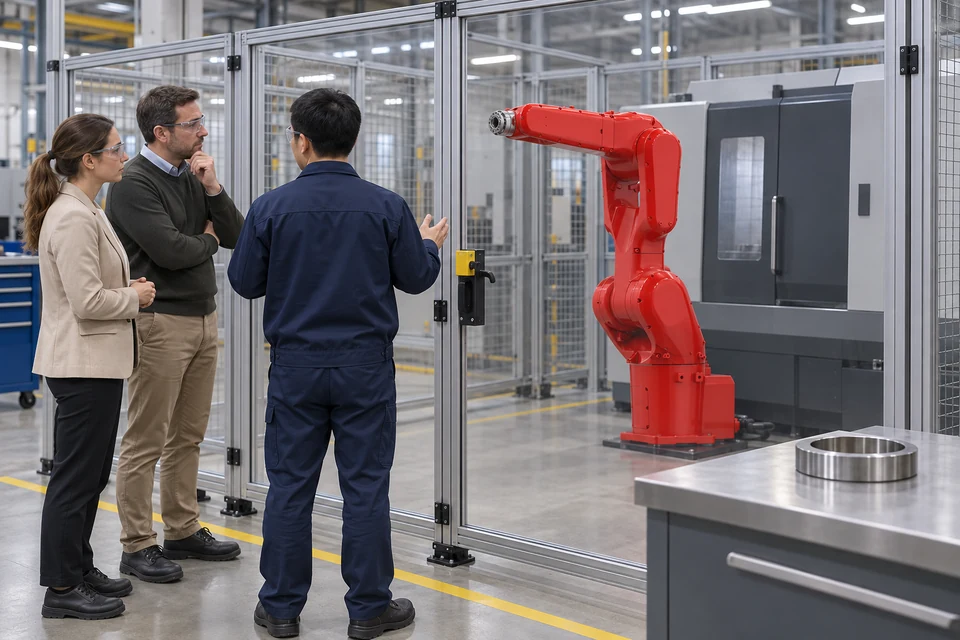 Application scenario illustration; not a customer site or performance result.
*Application scenario illustration; not a customer site or performance result.*
Does a round part automatically allow internal gripping? No. External gripping concerns contact from the outside, while internal gripping concerns contact from the inside. For the internal concept, a reachable inner contour or opening is still needed; a round outside profile by itself does not establish that inside contact is available.[^festo]
Outside or inside: identify the contact side
The first distinction is simply where the workpiece is contacted. Festo describes external clamping as holding a workpiece or tooling component from the outside, and internal clamping as holding it from the inside.[^festo] For a round blank or finished part in a one-CNC tending cell, this is a contact-geometry question before it is any broader equipment decision.
Calling a part “round” therefore leaves an important detail unresolved. An outside diameter can be visible while an inner surface may be absent, obstructed, or irrelevant to the intended handoff. The useful starting point is to name the side that would be contacted, without treating that label as proof that a particular arrangement is suitable.
A round outside shape is not enough for internal gripping
An internal-gripping concept presupposes an accessible inner contour or circular opening.[^festo] If no suitable internal surface can be reached, the outside shape alone does not establish internal gripping as the contact direction. This is a geometry and access boundary, not a dimensional rule or an instruction to alter the part.
At this point, keep the question narrow: is there an inside surface that can be discussed as a possible contact side? The answer should not be inferred from the presence of a central feature in a drawing, nor from the fact that the part is rotationally shaped. Details that have not been verified remain open.
 Application scenario illustration; no real meeting, gripping test or compatibility finding.
*Application scenario illustration; no real meeting, gripping test or compatibility finding.*
Gripper category does not decide the contact direction
A product category cannot settle the contact side on its own. On its gripper page, Festo lists parallel grippers for both internal and external gripping.[^festo] It also describes three-point grippers as able to pick a workpiece centrally and to be used for either direction.[^festo] Those examples are limited to that source's descriptions; they do not establish access, fit, force, or surface suitability for a specific part.
| Contact concept | Surface involved | Question to resolve |
|---|---|---|
| External gripping | An accessible outside surface | Which outside area can remain available for contact? |
| Internal gripping | An accessible bore or inner contour | Is an inside surface or opening reachable for the concept? |
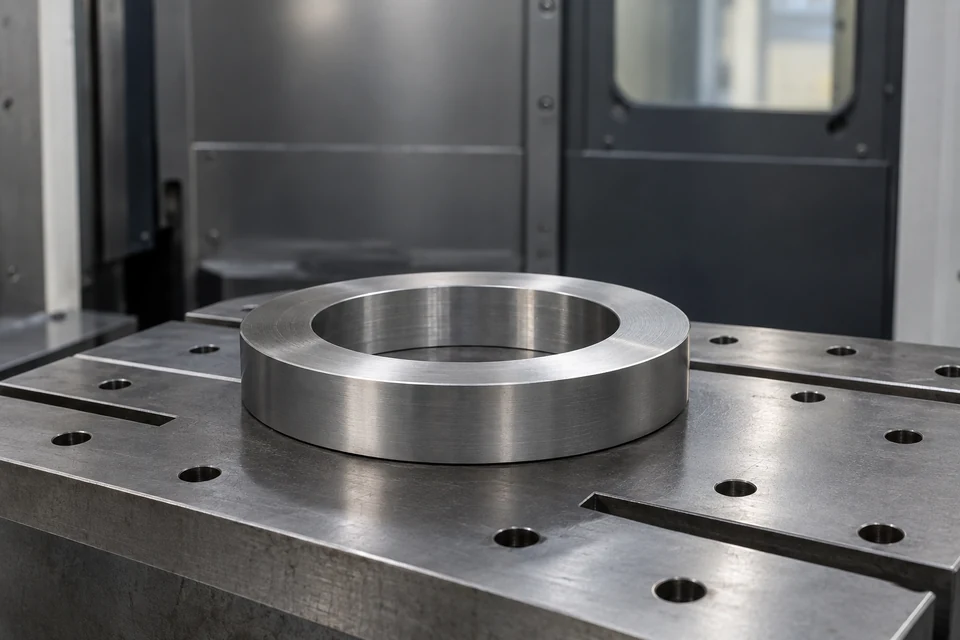 Application scenario illustration; not an engineering drawing, gripping test or performance proof.
*Application scenario illustration; not an engineering drawing, gripping test or performance proof.*
What must remain accessible at the CNC handoff?
Before choosing a contact concept, a bounded review can record the accessible outside surface, any accessible bore or inner contour, approach clearance, and surfaces that must remain available to the chuck or process.[^festo] These are project questions, not a completed gripper design or compatibility decision.
For broader design context, see CNC gripper design context. A separate Complete wrist-load review addresses load evidence rather than contact geometry. Neither page answers which contact side is available for the part at hand.
Frequently asked questions
Can every round part be gripped from the inside?
No. An accessible inner contour or opening must exist before inside contact can be discussed; a round outside profile does not supply that evidence.[^festo]
Does a parallel gripper always grip the outside?
No. The cited Festo page lists parallel grippers for internal and external gripping, so the category alone does not identify the contact side.[^festo]
Does central pickup prove the part will fit and be held correctly?
No. Festo's three-point example does not prove access, fit, force, or surface suitability for a particular round part.[^festo]
Which part features should a factory discuss before choosing a contact concept?
Discuss the accessible outside surface, any accessible bore or inner contour, approach clearance, and surfaces needed by the chuck or process. That discussion does not complete gripper selection.[^festo]
Source and use boundary
[^festo]: Festo — Grippers. Used only for the inside-versus-outside contact definitions, accessible inner-contour boundary, and the limited parallel- and three-point-gripper examples. It is not used here to select equipment or establish force, fit, performance, or compatibility.
Discuss your one-CNC part-handling requirements with existing part information, accessible surfaces, and chuck or process restrictions.