Application Note / 2026-09-20
CNC Robot Integration Responsibility Matrix: Who Owns Each Handoff?
A coordination worksheet for recording CNC robot handoffs, evidence owners, approvers and open scope without assigning contractual or legal liability.
 Application scene visualization / final solution subject to engineering review.
A CNC robot integration responsibility matrix should record each boundary or deliverable, the party to confirm supply or integration, the evidence verifier and authorized approver, the evidence location and current version, and whether the item is included, excluded, or open. Organization names come from actual agreements and configuration records. The worksheet coordinates handoffs; it does not allocate legal liability, interpret a contract, or authorize acceptance.
Define functions before filling in organization names
“Factory,” “machine builder,” “robot supplier,” and “integrator” are useful labels, but they do not automatically allocate a task. The integrator function may be carried out by the acquirer, a supplier, or a separate integrator. Start by naming the function that needs confirmation, not by assuming that a label settles ownership.
Which role has actually been agreed?
Use the project’s actual agreement and current configuration evidence to populate a row. If the function or evidence owner is not documented, leave the assignment open for confirmation. The matrix should make uncertainty visible rather than creating a default owner.
Give each deliverable and system boundary its own row
Keep final engineering, documentation, hardware procurement, custom software, installation, testing, and commissioning as separate rows. Physical and control handoffs also need their own rows: CNC to robot, robot to end effector, material presentation, and safeguards. For each boundary, distinguish who is to supply, integrate, verify, and approve the evidence.
This is a coordination view, not a signal diagram. The detailed inputs for a later specialist review can be linked through the machine-interface review inputs; this article does not repeat a door, chuck, cycle-start, or emergency-stop signal list.
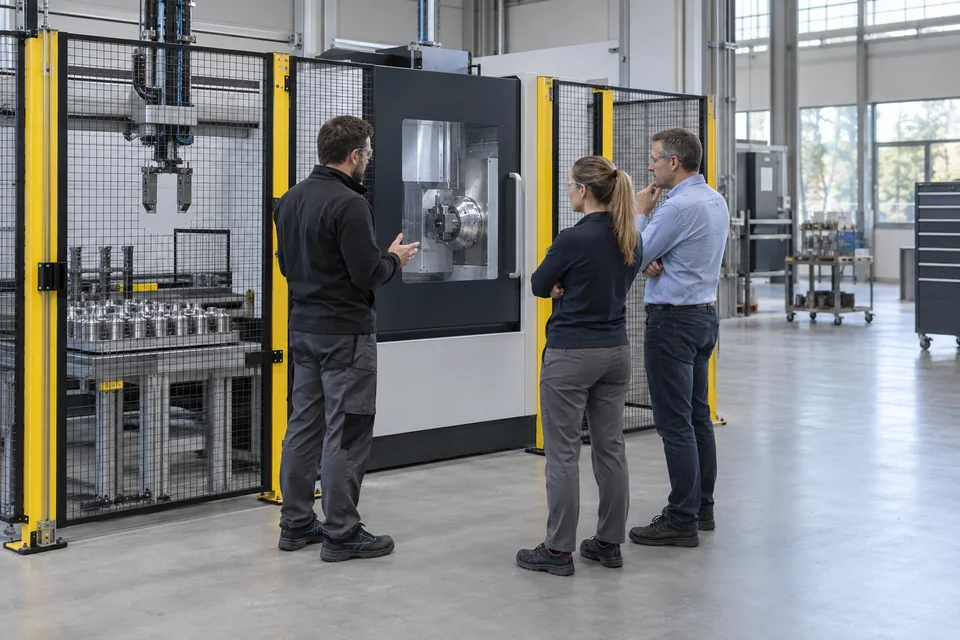 Application scene visualization / final solution subject to engineering review.
Leave scope gaps open until the evidence supports an assignment
Support, maintenance, upgrades, substitutions, mounting, fixturing, end effectors, vision, and training should remain explicit included, excluded, or open items. A complete-cell package title does not close these rows. The actual project documents decide whether an item is in scope and who confirms it.
Who must clarify an unassigned boundary?
Enter a confirmation owner field and retain the status as open until evidence supports an assignment. Do not invent escalation dates, service promises, warranty coverage, or an interface owner.
Make evidence location and current status part of handover
A handover is easier to review when every requirement, test, document, and open item names its evidence location, current version, and responsible owner. The same approach can point to the later acceptance-evidence planning record without creating acceptance criteria or declaring that testing is complete.
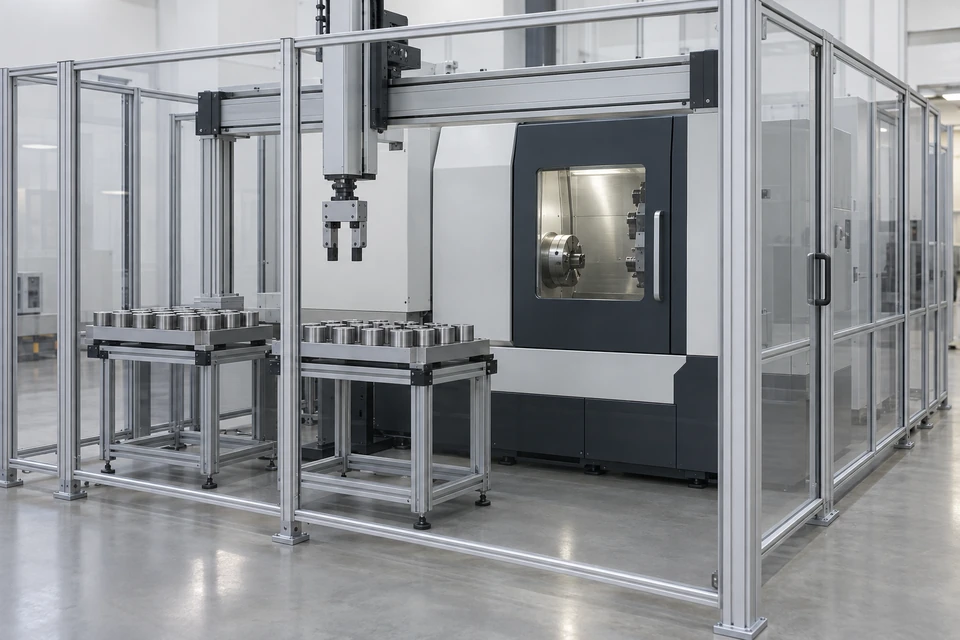 Application scene visualization / final solution subject to engineering review.
| Boundary or deliverable | Supply/integration owner to confirm | Evidence verifier and authorized approver to confirm | Evidence location/current version | Included/excluded/open status and confirmation owner |
|---|---|---|---|---|
| CNC–robot | ||||
| Robot–end effector | ||||
| Material presentation | ||||
| Safeguards boundary | ||||
| Engineering/documents | ||||
| Hardware/software | ||||
| Installation/testing/commissioning | ||||
| Training/support |
The completed worksheet remains a coordination record. It does not establish legal liability, included scope, contractual interpretation, certification, or acceptance.
Frequently asked questions
Is the robot supplier always the integrator?
No. Organization labels do not decide the function. Record the arrangement that the actual project documents support.
Should supply and verification be recorded as the same responsibility?
Record the functions separately. The actual agreement determines whether one party or different parties perform them.
Does a complete-cell package title close every responsibility row?
No. Keep included/excluded status and unresolved support or interface scope explicit.
Does a completed matrix establish legal liability or acceptance?
No. It supports coordination; actual project documents, verification, and authorized approval remain separate.
Source boundary
This worksheet uses only QX053-F01–QX053-F05: the possible location of an integrator function, separable delivery categories, named handoff evidence, explicit scope gaps, and traceable evidence ownership. It does not determine a QIXING obligation, a project party’s liability, compatibility, safety, or result.
Discuss the open boundaries
Share your project boundary and ownership questions with the actual project scope, proposed parties, available evidence, and unresolved boundaries for coordination review. Do not publish confidential contracts; this request does not promise legal advice, included scope, or acceptance.