Application Note / 2026-09-20
Older CNC Robot Tending Retrofit: What to Check Before Engineering Review
A screening worksheet for an older CNC: collect condition, records, support and configuration evidence, then continue, reassess or request more evidence.
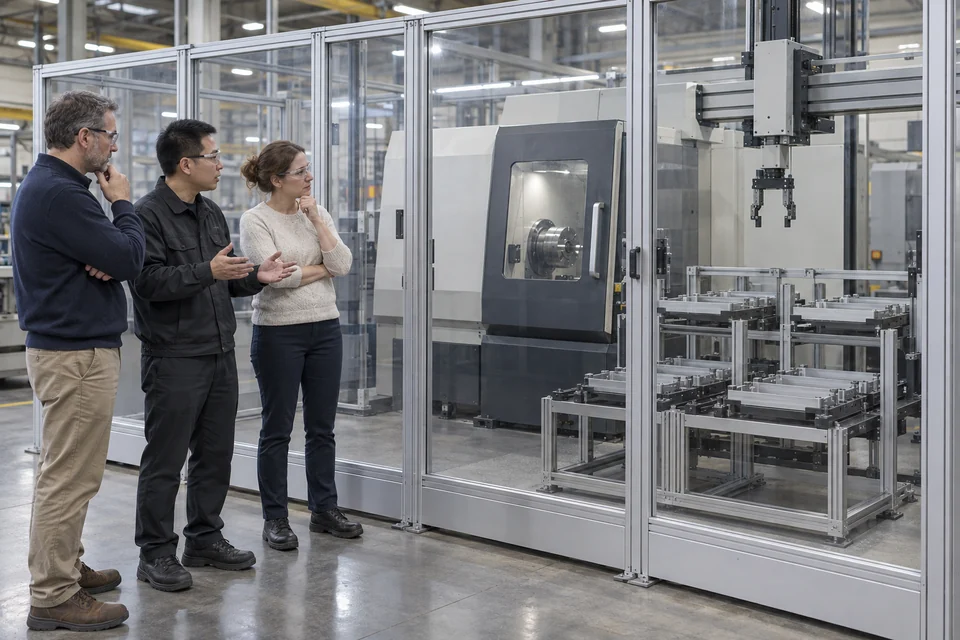 Application scenario illustration / final layout subject to engineering review.
Before an older CNC enters a robot-tending retrofit engineering review, collect evidence of its present working condition, open faults, maintenance history, controls and drives, available records, support terms, and operator knowledge. The result is only one of three routes: continue to review, reassess, or request missing evidence. It does not determine that a machine is compatible, unsuitable, safe, or ready for installation.
Start with current condition, not a machine-age cutoff
Begin with what the plant can document now: current working condition, unresolved faults, maintenance history, and whether maintenance logs and instructions are available and current. This is a screening record, not a fault diagnosis or a repair instruction. A calendar age by itself does not describe the condition of a particular CNC.
What is known and what remains undocumented?
Mark evidence that is actually available, including its configuration and date. For each gap, record the responsible party and the next review step. Do not reconstruct a history from memory or turn a missing record into a conclusion about the machine.
Separate mechanical condition from control and drive obsolescence
Mechanical condition and control/drive obsolescence are different review questions. A vendor example may describe a retrofit context where mechanical components are in good condition while controls or drives are outdated; that distinction can organize questions for this CNC, but it cannot decide candidacy for another machine.
Do not create an age threshold, reliability score, replacement rule, cost comparison, or retrofit recommendation from this distinction. The purpose is to ensure that the evidence for the mechanical side and for the control side is requested separately.
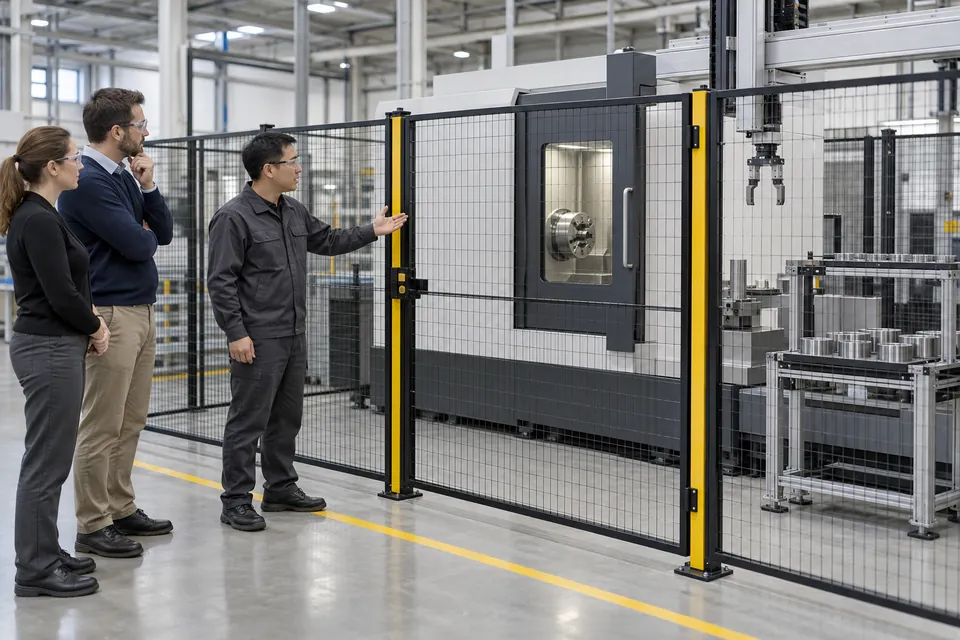 Application scenario illustration / final layout subject to engineering review.
Request configuration-specific support and interface evidence
Ask the OEM or control supplier for support term, component availability, connectivity, service coverage, and training information for the actual CNC, control, and software configuration. Request a configuration-specific answer about future robot automation rather than treating a general statement as proof.
Has future robot compatibility been answered with evidence?
A positive-sounding description, or the presence of a later machine-interface evidence checklist, is not compatibility evidence for this CNC. That specialist checklist belongs to a later review. At this screening stage, record the exact configuration, the requested evidence, the response owner, and what remains unanswered; do not reproduce or design a signal, door, chuck, cycle-start, or emergency-stop interface.
Make the next review step explicit
Operators and maintainers who know the current process should identify recurring inconsistencies, manual interventions, training needs, and production constraints. Their observations supply context for a formal review; they do not authorize an installation or operation. Missing site context can be assembled alongside the CNC site-input checklist, without treating it as a completed engineering assessment.
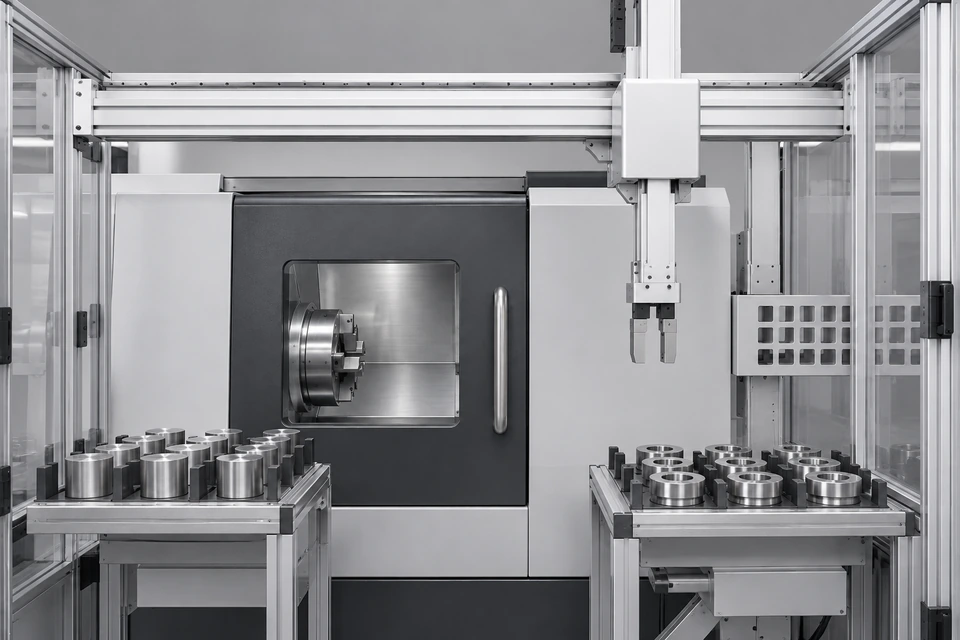 Application scenario illustration / final layout subject to engineering review.
| Review question | Current evidence and configuration/date | Gap and responsible party | Next review step |
|---|---|---|---|
| Mechanical condition and open faults | |||
| Maintenance records and instructions | |||
| Controls and drives | |||
| OEM and component support | |||
| Configuration-specific robot interface evidence | |||
| Operator interventions, training, and production constraints |
Use the completed worksheet to route evidence gaps. A route to further review is not an acceptance finding, an OEM authorization, a support-availability promise, or a successful retrofit claim.
Frequently asked questions
Is machine age enough to rule a retrofit in or out?
No universal cutoff applies here. Separate current condition from controls and drives, then request the evidence needed for this exact CNC.
Does a mechanically sound machine automatically support robot tending?
No. Mechanical condition does not answer configuration-specific robot-automation compatibility.
What should be requested from the OEM or control supplier?
Request support term, component availability, connectivity, service, and training information for the actual configuration. Do not assume any of these are available.
What if maintenance records or operator knowledge are missing?
Record the gap and its owner before the next review. Do not invent a condition or move to an engineering conclusion.
Source boundary
This screening structure uses only QX050-F01–QX050-F05, drawing on UK HSE maintenance-record concepts, a Siemens vendor-specific distinction between mechanical condition and obsolete controls/drives, FANUC’s evidence questions, and NIST guidance on involving process experts. These sources do not establish support, compatibility, safety, compliance, or results for any QIXING system or any particular CNC.
Discuss the evidence gap
To frame a scoped discussion, share your older-CNC review inputs: machine/control identity, available maintenance records, unresolved issues, and OEM responses. This request does not promise suitability, support availability, or a successful retrofit.