Application Note / 2026-09-21
Manual CNC Tending Work Measurement: Build a Baseline Before Automation
A task-observation worksheet for separating existing CNC tending work, travel, machine time, waiting, and multi-machine overlaps without scoring workers or forecasting savings.
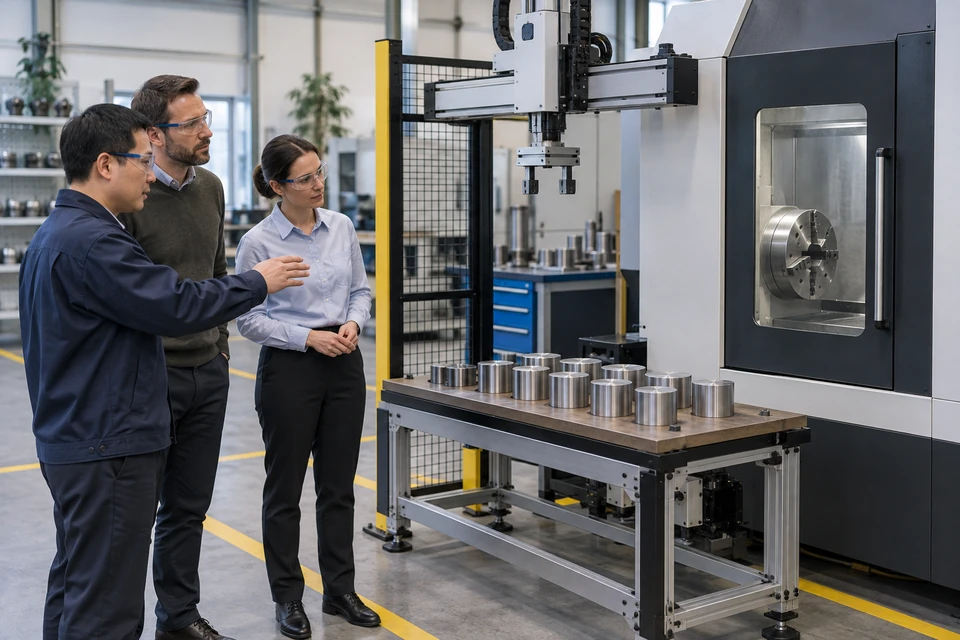 Application scene visualization / final solution subject to engineering review.
Before automation, a manual CNC tending baseline should record the observed machine, part, operation, shift, and operating conditions; separate actual task categories and preserve their timeline overlap. Manual work, walking, processing, waiting, replenishment, inspection, and interruptions are not automatically sequential. The record describes current work only: it does not set staffing, robot cycle time, OEE, ROI, or a worker rating.
Set the observation boundary with the people who know the work
Start by naming the machine, part, operation, shift, and conditions represented by the record. Review the task sequence with people who know the current process so omitted steps and occasional inconsistencies can be surfaced. The subject is the task under stated conditions, not the person doing it.
What situation does this record describe?
Use a condition field for the observed work context and an evidence field for what was seen. Do not collect names, employee IDs, performance ratings, or surveillance-style judgments. A useful record makes its limits visible rather than treating one observation as a universal description of the operation.
Separate work categories without losing the actual sequence
Distinguish manual work, walking, machine processing, and waiting while retaining the actual event order. Within the stated scope, include replenishment and take-away, loading and unloading, inspection, observation, cleaning, and abnormal or maintenance interactions that actually occur. Do not invent a frequency or duration for a task that was not observed.
The CNC project input checklist can help identify machine and part context, but it does not produce a work-measurement result.
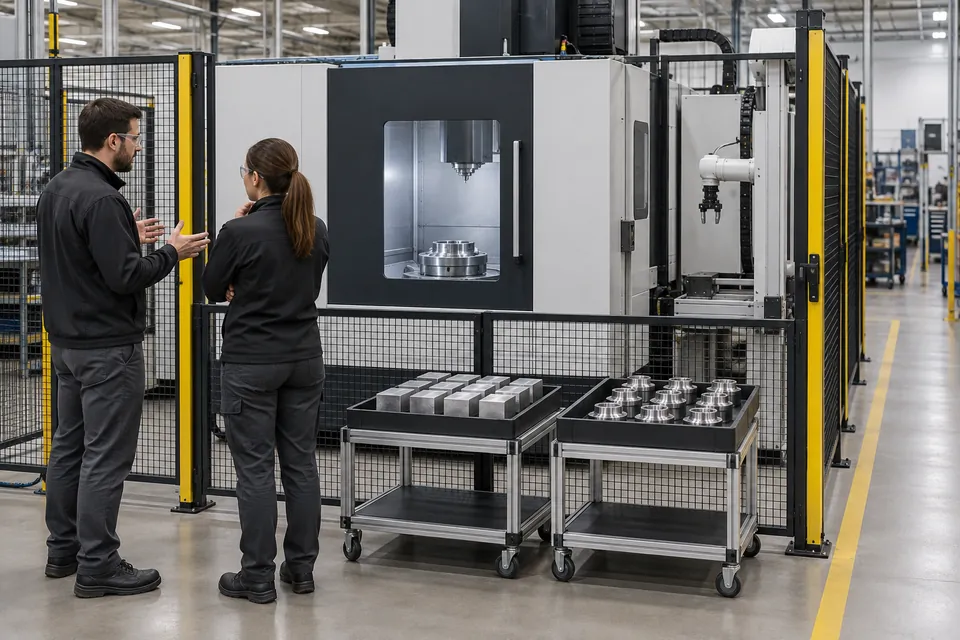 Application scene visualization / final solution subject to engineering review.
Preserve overlaps, travel, and interruptions
When one person attends more than one machine, record which events overlap, which machine and condition they belong to, and where travel or an interruption occurs. A simple total can misrepresent the observed work when machine processing or waiting coincides with another activity.
Why can a simple sum misrepresent the observed work?
Adding every category as sequential labor removes the actual concurrency pattern. Keep the timeline or sequence reference alongside the concurrent event. This worksheet does not calculate a labor standard, utilization, unattended capacity, or a staffing conclusion.
Keep the baseline separate from automation decisions
Use the completed record to show observations and evidence gaps under the stated conditions. It is not a comparison between workers or a forecast of what automation will achieve. Robot-cycle segmentation, staffing decisions, ergonomic or safety assessment, and promised results remain separate project work.
A single-machine tending context page may provide downstream application context, but it is not a time or labor-savings comparison.
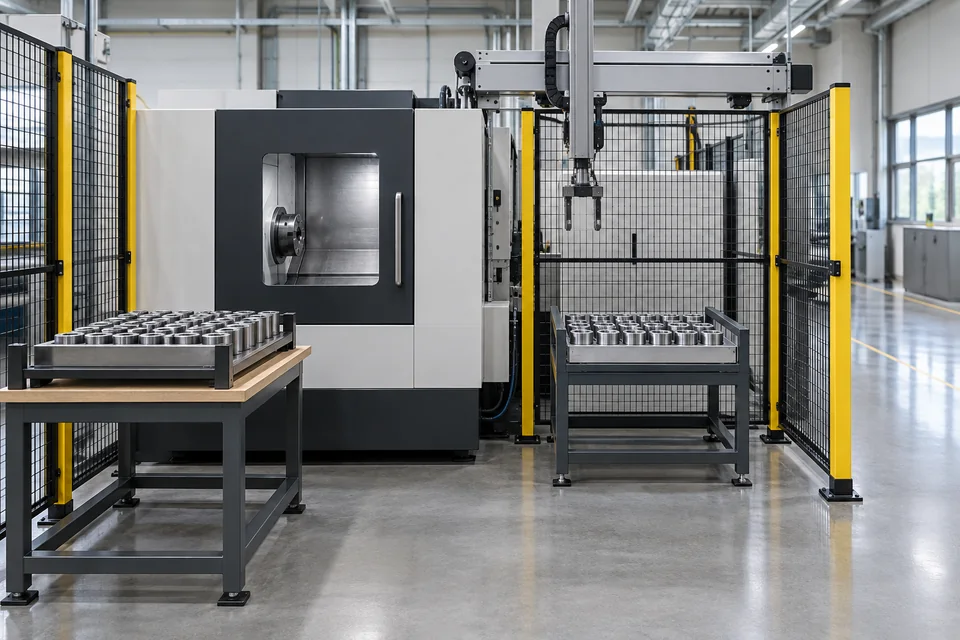 Application scene visualization / final solution subject to engineering review.
| Observed machine / part / operation / condition | Task category and actual event | Observed start/end or sequence reference | Concurrent event / travel / interruption | Evidence and uncertainty |
|---|---|---|---|---|
Use blank rows for actual replenishment, loading/unloading, inspection, cleaning, abnormal interaction, machine processing, or waiting as applicable. Do not enter worker identifiers, sample times, summed labor totals, averages, standard cycles, staffing scores, OEE, or benefit calculations.
Frequently asked questions
Can machine processing time be added to manual work time?
Record overlap first. Do not assume the categories are sequential.
Should replenishment and occasional interventions be left out?
Include the events that actually occur within the stated scope; do not invent their frequency or duration.
What changes when one person attends several machines?
Preserve event sequence, machine context, overlap, travel, and interruption rather than making a context-free total.
Can this record show how many operators automation will replace?
No. Observations under recorded conditions do not establish staffing, robot cycle time, or economic outcomes.
Source boundary
This article uses only QX056-F01–QX056-F05 for task observation and concurrency fields. It is not a job-hazard analysis, safety or ergonomic assessment, labor standard, verified QIXING software function, customer result, or automation commitment.
Discuss the observation scope
Discuss your CNC task-observation scope by sharing an anonymized task sequence, machine/part conditions, overlaps, and unresolved questions for project scoping. Do not submit worker surveillance; this discussion does not promise staffing reductions, faster cycles, or savings.