Application Note / 2026-08-28
CNC Machine Tending Interface Checklist: Door, Chuck and Robot Handoffs
A one-machine tending interface review needs measured geometry, named machine states and explicit handoff confirmations. This checklist separates confirmed data, measurements still needed and project decisions.
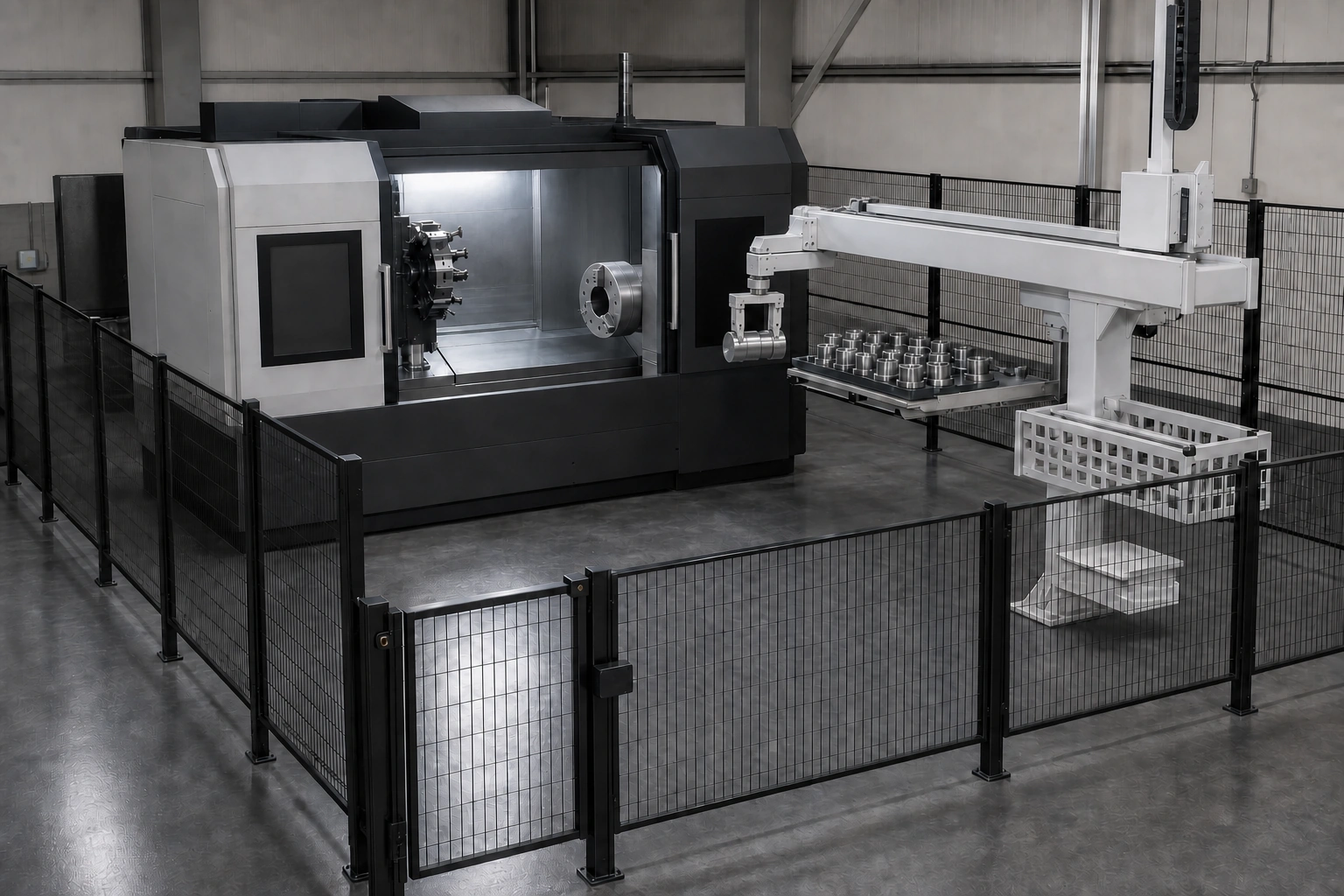 Application scene visualization / final layout subject to engineering review
A CNC machine tending interface checklist should record seven things: measured machine geometry, door states, chuck or fixture states, conditions for robot entry/exchange/retreat, the normal restart handoff, emergency-stop and guarding boundaries, and abnormal recovery conditions. Each item should be marked as confirmed, measurement required or project decision required. The checklist is a review document, not a PLC program, validated safety architecture or compatibility approval.
Define the handoff document before defining signals
The interface exists where one CNC machine and one robot exchange physical access, part state and permission to proceed. The checklist should show what condition starts a step, what confirms that step has ended and who owns an unresolved condition.
Use three review statuses throughout the document:
| Review status | Meaning | Required follow-up |
|---|---|---|
| Confirmed | Supported by a current drawing, measurement or documented machine condition | Record the source and revision |
| Measurement required | Physical geometry or machine behavior is still unknown | Assign a measurement or observation |
| Project decision required | The integration team must define and validate the implementation | Record the owner and validation point |
The single-machine CNC tending flow provides the application context. This article stays with the machine-to-robot interface and does not select a robot architecture, gripper or tray arrangement.
Section one: record actual machine geometry and access
Start with the machine as installed, not with a model-name assumption. Record the actual door opening, spindle-centre height, chuck or fixture envelope, roof clearance, service panels and operator path. Unknown dimensions remain open inputs; they cannot be used to infer robot reach, clearance or compatibility.
| Physical input | Confirmed data or measurement needed | Evidence | Status |
|---|---|---|---|
| Door opening and location | ______ | ______ | ______ |
| Spindle-centre height | ______ | ______ | ______ |
| Chuck or fixture envelope | ______ | ______ | ______ |
| Roof clearance | ______ | ______ | ______ |
| Service-panel access | ______ | ______ | ______ |
| Operator and maintenance path | ______ | ______ | ______ |
For the broader site-survey context, see CNC automation site data. The interface checklist uses only the geometry and access fields needed for this handoff review.
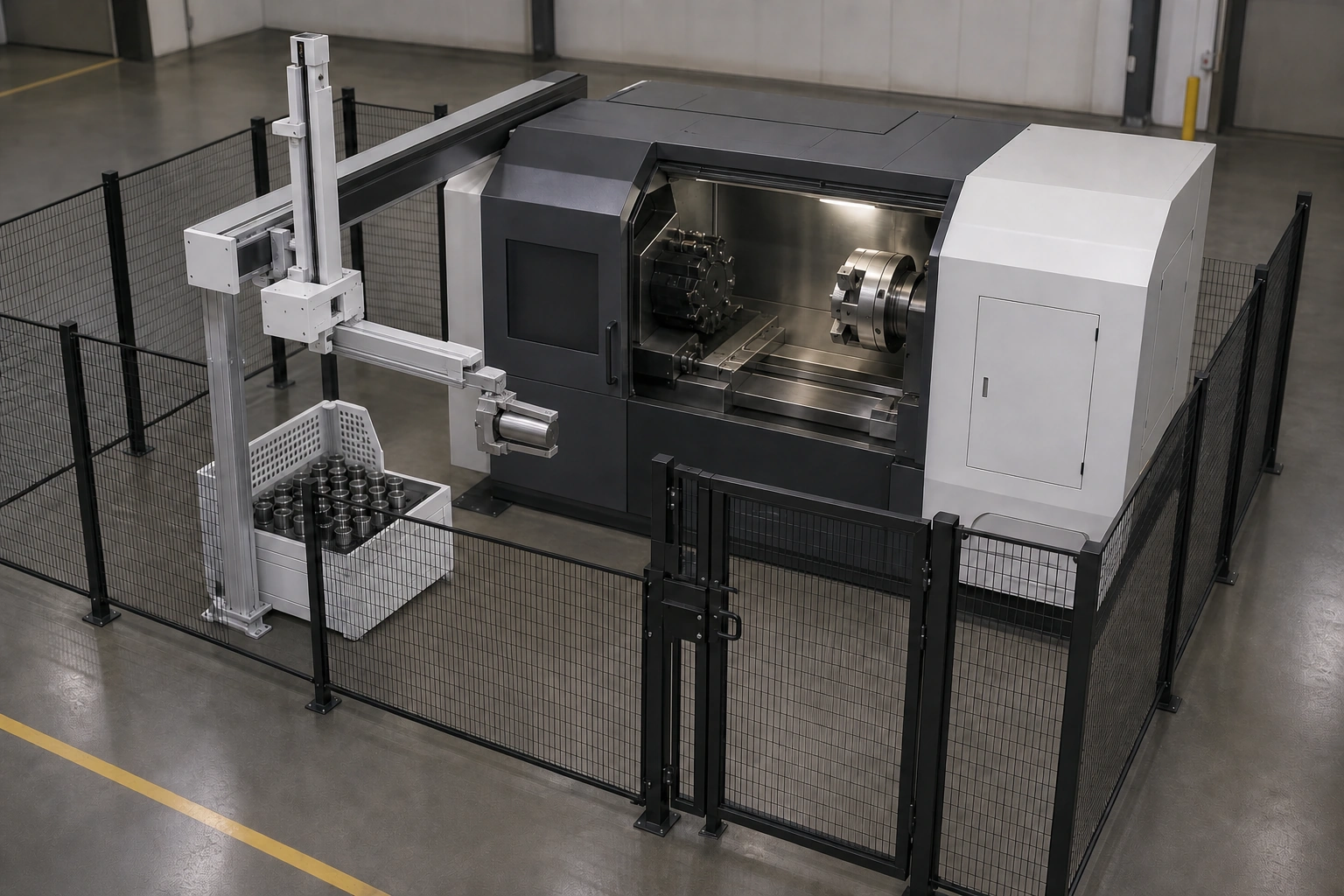 Application scene visualization / final layout subject to engineering review
Section two: name door and chuck states for each handoff
The checklist should identify door-open and door-closed states, together with chuck-release and chuck-clamp states. It should also record the conditions that permit robot entry, part exchange and robot retreat.
Do not turn these state names into invented I/O labels, voltages, protocols, contact types or signal timing. A reported status is an interface input; it is not proof that the commanded mechanical state is safe.
| Handoff point | Door state to document | Chuck/fixture state to document | Entry or completion condition | Status |
|---|---|---|---|---|
| Before robot entry | ______ | ______ | ______ | ______ |
| Before part exchange | ______ | ______ | ______ | ______ |
| Before robot retreat | ______ | ______ | ______ | ______ |
| Before door close | ______ | ______ | ______ | ______ |
| Before machining restart | ______ | ______ | ______ | ______ |
State and permissive are not the same field
A state describes what has been reported, such as door open or chuck clamped. A permissive records the reviewed conditions that allow the next action. The project must define how the actual machine proves and uses those conditions; this article does not prescribe the implementation.
Section three: map the normal handoff through restart
The normal review path runs from machining complete through door and chuck actions, robot-safe-position confirmation, door close and machining restart. Each row needs a start condition and an end confirmation. It is not a universal PLC sequence and must not bypass existing interlocks.
| Review step | Start condition to document | Action owner | End confirmation to document | Open question |
|---|---|---|---|---|
| Machining complete | ______ | CNC / project-defined | ______ | ______ |
| Door action | ______ | Project-defined | ______ | ______ |
| Chuck or fixture action | ______ | Project-defined | ______ | ______ |
| Robot entry and exchange | ______ | Robot / project-defined | ______ | ______ |
| Robot retreat | ______ | Robot / project-defined | Robot-safe position: ______ | ______ |
| Door close | ______ | Project-defined | ______ | ______ |
| Machining restart | ______ | CNC / project-defined | ______ | ______ |
The public article used to map the full machine-tending sequence can provide action-order context. No time, throughput or cycle result from that topic is carried into this checklist.
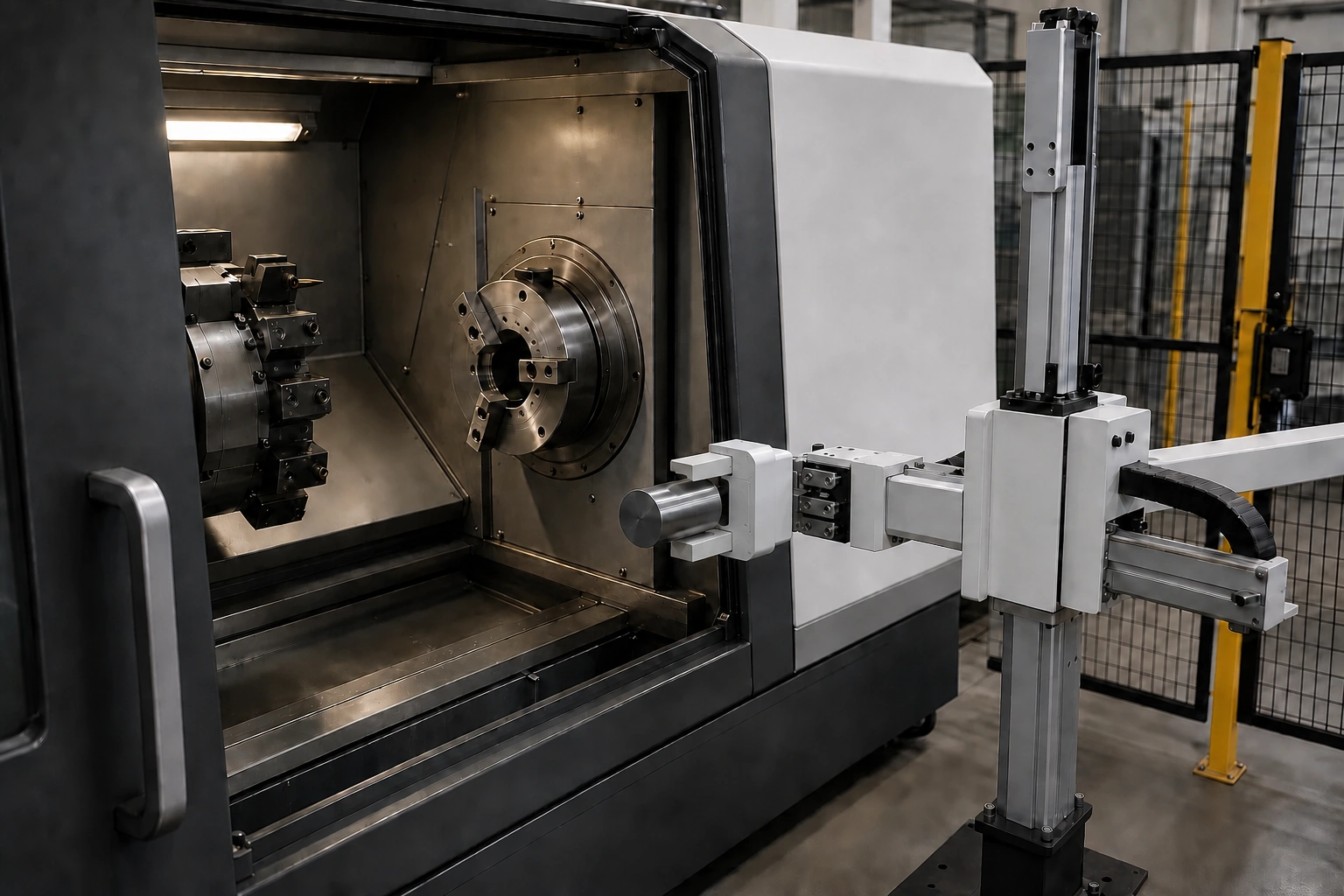 Application scene visualization / final layout subject to engineering review
Section four: include emergency-stop behavior and guarding boundaries
Emergency-stop behavior belongs in the interface and recovery review, but an emergency stop alone is not a safeguarding strategy. The project review must separately address access to the point of operation, rotating parts, flying chips and the controlled paths used by operators and maintenance personnel.
Record the following without assigning an unverified performance level, category, stop time or safe distance:
- what machine and robot states are expected after an emergency stop;
- what part-state uncertainty may remain;
- which access boundaries and guarded areas require project evaluation;
- what conditions must be reviewed before manual intervention;
- what confirmation is required before a restart decision.
The general machine-guarding principle used here cannot prove that a project meets OSHA or local legal requirements, and it cannot determine a project-specific fence layout. A broader safeguarding and recovery review remains a separate project activity.
Section five: document abnormal states and recovery ownership
Normal permissives are only part of the handoff. The checklist must also cover loss of a door or chuck condition, emergency stop, uncertain part state and manual intervention. For each case, record the expected stopped condition, who reviews the condition and what must be confirmed before restart.
| Abnormal state | State to record | Review owner | Condition required before restart | Status |
|---|---|---|---|---|
| Door condition lost or uncertain | ______ | ______ | ______ | ______ |
| Chuck/fixture condition lost or uncertain | ______ | ______ | ______ | ______ |
| Emergency stop | ______ | ______ | ______ | ______ |
| Part state uncertain | ______ | ______ | ______ | ______ |
| Manual intervention required | ______ | ______ | ______ | ______ |
Do not fill gaps with an assumed automatic-recovery sequence. Recovery logic, manual access and restart validation remain machine- and project-specific.
Review-ready CNC machine tending interface checklist
Use this condensed table as the handoff cover sheet. Attach drawings, measurements and state descriptions rather than replacing missing data with assumptions.
| Checklist group | Required input | Classification | Evidence/reference | Next action |
|---|---|---|---|---|
| Machine geometry | Opening, spindle centre, chuck/fixture envelope, roof, panels, paths | ______ | ______ | ______ |
| Door/chuck states | Open/closed, release/clamp, entry/exchange/retreat conditions | ______ | ______ | ______ |
| Normal handoff | Start condition and end confirmation for each step | ______ | ______ | ______ |
| Emergency stop | Expected states, part uncertainty and restart review | ______ | ______ | ______ |
| Guarding/access | Point of operation, rotating parts, flying chips, controlled access | ______ | ______ | ______ |
| Abnormal recovery | Lost conditions, uncertain part state, intervention and recovery ownership | ______ | ______ | ______ |
FAQ
What is the difference between a state and a permissive?
A state records a reported machine condition, such as door open or chuck clamped. A permissive records the reviewed conditions that allow the next action. The actual signal implementation and proof of the mechanical condition remain project-specific.
What normal door, chuck and robot handoff should be reviewed?
Review machining complete, the required door and chuck actions, robot entry and part exchange, robot-safe-position confirmation, door close and machining restart. Give every step a start condition and an end confirmation without treating the table as universal PLC code.
Why does an emergency stop not replace safeguarding?
Emergency-stop behavior is one interface and recovery input. Controlled access and guarding around the point of operation, rotating parts, flying chips and robot motion require a separate project evaluation; an emergency stop alone does not establish that those hazards are addressed.
Which abnormal and recovery conditions belong in the checklist?
Include loss or uncertainty of a door or chuck condition, emergency stop, uncertain part state and manual intervention. Record the stopped state, review owner and conditions required before restart, without assuming an undocumented automatic-recovery sequence.
Sources and use boundaries
- Machine geometry, states and handoffs use QIXING's public CNC automation site data and verified facts
QX005-F01throughQX005-F03andQX005-F06. - The guarding boundary is limited to the general principles in 29 CFR 1910.212 and OSHA's interpretation on emergency stops and guarding. These sources cannot prove that a project meets regulatory requirements.
- The public ISO scope identifies integration and recovery as review topics; it does not prove that a project meets ISO requirements.
- Image positions are instructions for a later image task. Every image must retain the application-scene disclosure and cannot serve as an interface drawing, clearance approval or performance evidence.
Submit the machine interface for review
Share the actual CNC door opening, chuck/fixture envelope, service-access layout, door and chuck states, normal handoff sequence and abnormal-state requirements, then submit your machine and interface data so QIXING can review the machine interface for a one-machine tending project.