Application Note / 2026-09-13
Why CNC Cycle Count, Robot Transfer Count, and Good-Part Count Differ
Before comparing counts in a one-CNC tending cell, establish the event, counted object, scope, and quality meaning behind each label.
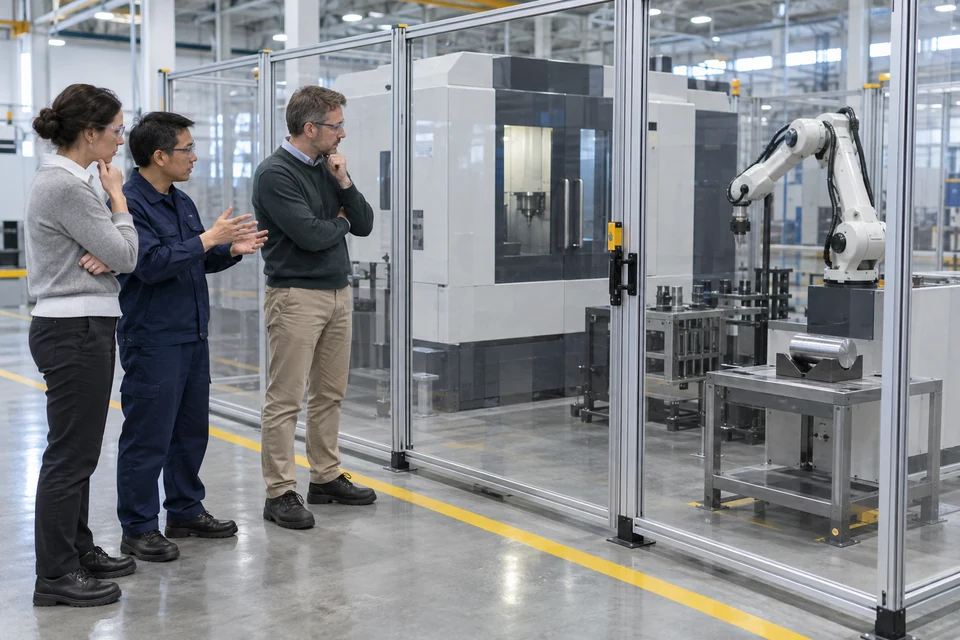 Application scenario illustration; not a real customer site, delivered system or performance proof.
*Application scenario illustration; not a real customer site, delivered system or performance proof.*
Should CNC cycle count, robot transfer count, and good-part count match? Not necessarily. Their increment event, counted object, scope, and quality meaning can differ. The cited OPC specifications illustrate counter semantics only; they do not describe a QIXING implementation or diagnose why values differ in a particular cell.
Start with the event behind a completed cycle
A count becomes meaningful only when its increment event is declared. In the OPC 40083 CycleParametersEventType, a plastics-machinery cycle model, a machine-cycle count is tied to a completed cycle event. That example is useful for separating an event from a later quality finding, but it is not a requirement for a CNC controller.
A completed machine cycle therefore does not, by itself, establish a downstream quality classification. Before comparing a cycle label with another number, the factory needs to know what completed event that local label represents and what its scope includes.
Separate produced parts from parts classified as good
The OPC 40501-1 ProductionStatisticsType describes a lifetime produced-parts counter whose definition carries no part-quality information. It is a different scope from a current job or a cycle counter. This type is deprecated in OPC 40501-1 v1.02.0, so it is a conceptual reference here, not an implementation recommendation.
The plastics cycle model separately exposes total, good, bad, and test-sample part fields. Those separate fields illustrate why a count called “cycle” cannot automatically be treated as a good-part count. They do not establish an inspection rule, defect rate, or production result for any CNC tending cell.
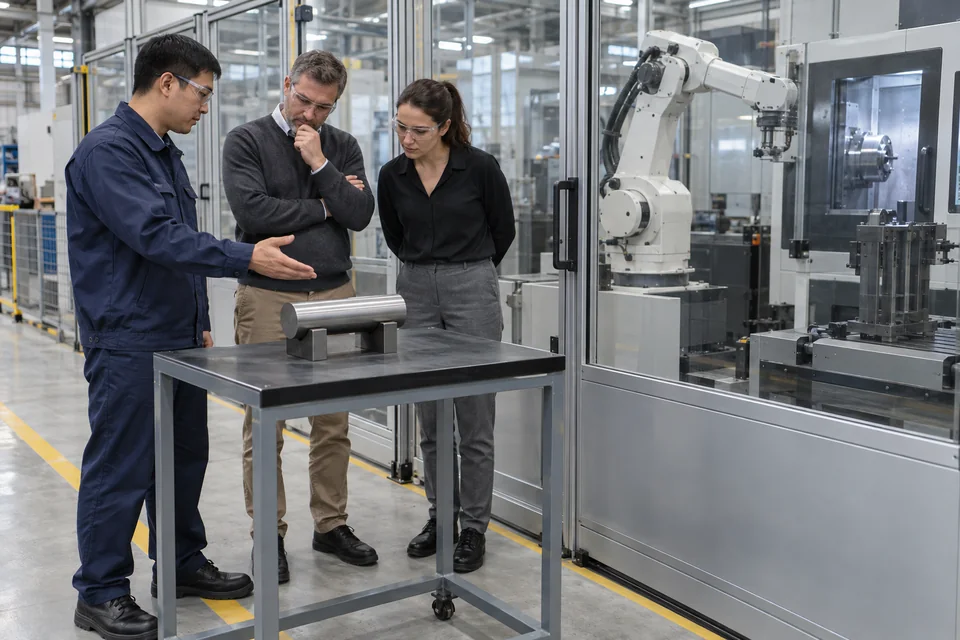 Application scenario illustration; fully generated people, no real meeting or quality finding.
*Application scenario illustration; fully generated people, no real meeting or quality finding.*
Define what a robot transfer counter actually counts
The OPC MachineryOperationCounterType shows a general principle: an operation counter increments on a defined activity transition. It does not define a standardized “robot transfer count.”
For an existing local counter, the question is what event it names: an attempt, a pickup, a placement, or a completed transfer. The scope and reset boundary also need to be stated. These are questions about the definitions already in use, not instructions to program, reset, or integrate a controller.
Compare meanings before comparing values
| Counter label | Meaning to establish | What the value does not establish |
|---|---|---|
| CNC cycle count | Finished-cycle event and its scope; the cited model is an illustration only | A downstream quality finding |
| Robot transfer count | Local attempt, pickup, placement, or completion boundary and scope | A standardized field or guaranteed one-to-one relationship |
| Good-part count | A good-part classification distinguished from total, bad, and test-sample fields | The factory's inspection rule or a quality result |
Before comparing values, ask whether the event, counted object, and scope are actually comparable. Machine-to-robot handoff review covers handoff states and permissives, while Tool-life counting versus broken-tool detection concerns a different counted object: cutting-tool use. Neither determines these count definitions.
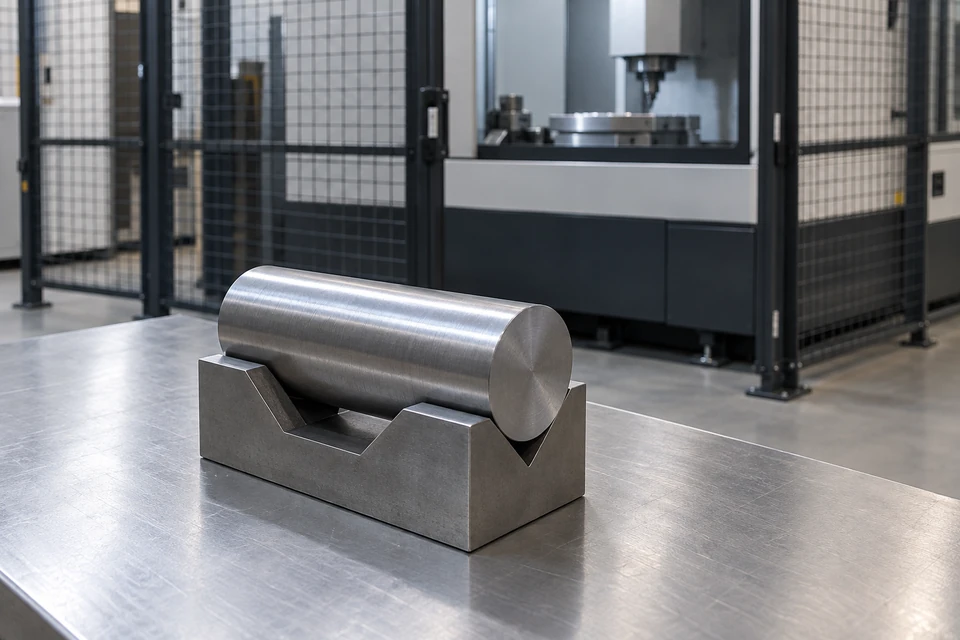 Application scenario illustration; not an engineering drawing, transfer record or quality result.
*Application scenario illustration; not an engineering drawing, transfer record or quality result.*
Frequently asked questions
Does one completed CNC cycle mean one good part?
No universal equivalence follows. A finished-cycle event and a good-part classification are different concepts in the cited models, without defining the actual part classification.
Does a lifetime produced-parts count include quality information?
In the cited, deprecated OPC 40501-1 ProductionStatisticsType, the lifetime produced-parts definition carries no part-quality information. This does not generalize to every controller.
Is robot transfer count a standardized field in these sources?
No. The sources do not standardize that label; establish whether the local definition counts an attempt, pickup, placement, or completed transfer, with its scope and reset boundary.
Can different totals alone prove a production or quality problem?
No. First establish the declared events, counted objects, and scopes. A mismatch alone is not a supported diagnosis or performance conclusion.
Sources and use boundary
This page uses OPC 40501-1, OPC 40083, and OPC 40001-1 only to explain bounded counter semantics. It does not assert that these fields are present in QIXING equipment, any CNC, robot controller, PLC, or customer cell.
Discuss the count definitions for your one-CNC tending cell by sharing existing counter labels and documented event or scope definitions; unknowns can remain open for discussion.